How it works
Down to the last wire.
How a robot tests your switchboard, from your electrical CAD project to the test report.
We will tell you plainly whether a robot can do it, and how.
How it works
From your CAD project to the test report, in three steps
Nobody programs the robot board by board. It starts from the data you already have and looks at the real switchboard.
It sees the real switchboard
Cameras and 3D sensors, with deep-learning models, find components, terminals and markers where they really are, not where the drawing puts them.
It starts from your connection list
The system imports the schematic and the connection list from your electrical CAD project, whatever the format, and builds the test sequence from them. A new board is not a new robot program.
It leaves the test report
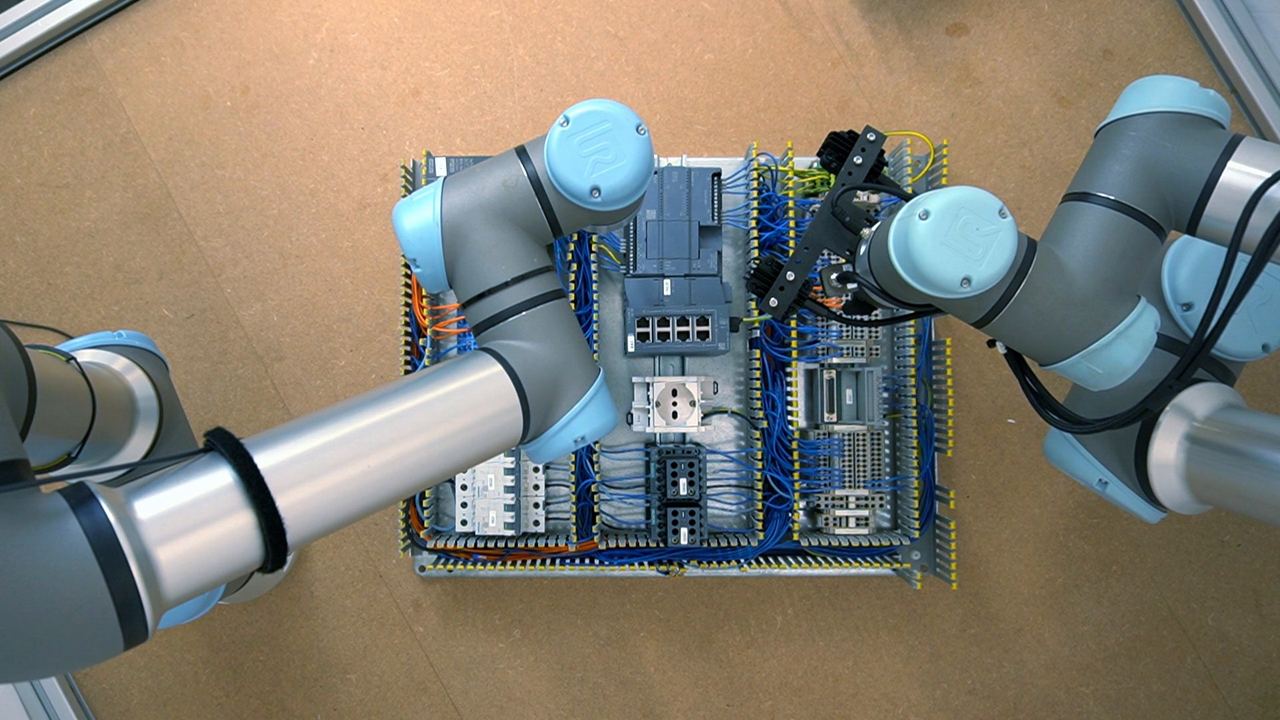
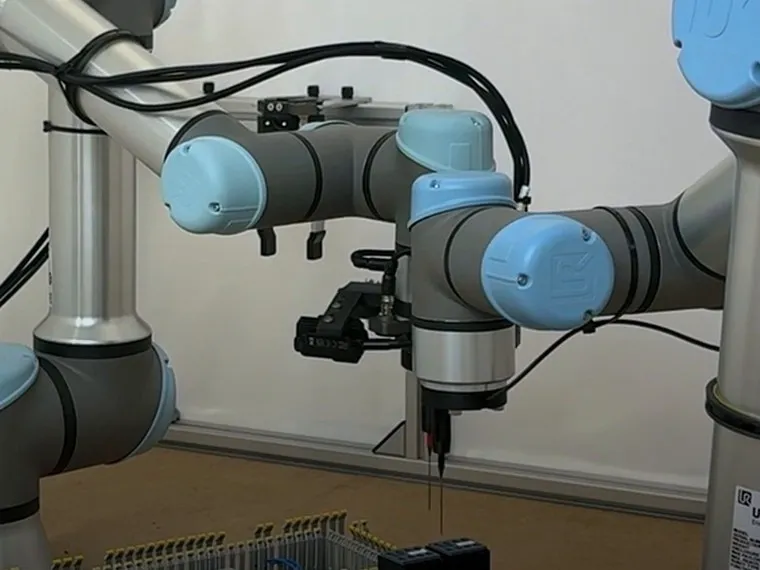
Two collaborative arms with custom probes check the continuity of each connection. Every test is logged: the board leaves with its report. The decisions stay with your tester.
Test report
Continuity test · from the connection list
- Terminal block to Relay coilOK
- Relay contact to Spring terminalOK
- Spring terminal to Controller supplyOK
- Controller output to Input moduleOK
- Input module to Power supply 0 VOK
- Power supply 24 V to Main connectorOK
- Terminal block to Earth barOK
7 of 7 connections checked
Inside: perception, CAD integration, cable-aware planning with a digital twin.
Prototype
A real prototype, on a real switchboard
Two collaborative arms with custom probes test the connections of an electrical switchboard. It is a prototype, and we call it that.
Status: working prototype
The prototype at work
Ninety seconds on a real switchboard, no sound.
What changes in your testing
Fewer hours of manual testing
The robot goes from point to point; the technician no longer spends the day with the probes in hand.
Every connection checked
The sequence comes from the connection list: every wire on the list gets its test, none is skipped in a hurry.
A report for your customer
Every switchboard leaves with its digital test report, traceable. Ready to hand over with the board.
Skilled people on the work that matters
The robot takes the repetitive round of the test points. The decisions stay with the people who know the trade.
Bring us a project.
We will tell you plainly whether a robot can do it, and how.
We reply within two working days.
- The cable comes up through the bench and lies straight along it.
- The left arm takes it and lays it into the R’s stem, its top corner and its top.
- The right arm takes it over and lays the bowl, the leg and the foot of the R.
- The right arm slides the copper ferrule onto the free end and crimps it. The robots park: the cable is the R of the logo.
Your request is ready to send.
Your email app should open with it, addressed to info@robosect.it. Press Send there: nothing leaves until you do.Nothing opened? Use Open the email again, or copy the message and write to info@robosect.it.
No email app?
Copy the message and send it to info@robosect.it from any email account.
We reply within two working days.
Prefer email? Write to
info@robosect.itVia Lazio 2, 40139 Bologna, Italy
Follow ROBOSECT on LinkedIn (opens in a new tab)